Robert Peterson
“Ek Is Khoisan”
We are six children, four boys and two daughters. We grew up in a God-serving zinc house, even though my father was a drinker. My mother wanted to make sure we went to school and didn’t get involved in any gang activities. Certain of our cousins were gang members and my mother didn’t want that for us. I ended my school career in 9th grade and went to work. As a 15-year-old, I found myself in trouble with the law in that I broke a gang member’s shoulder and rib bones.
My 1st Born
In 1980, I became a father to a beautiful little girl.
Behind Bars:
I then found myself in great Trouble again, and this time I was serving a prison sentence.
Turning Point:
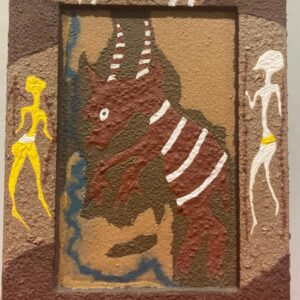
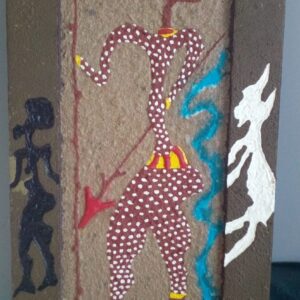
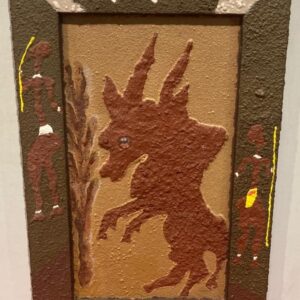
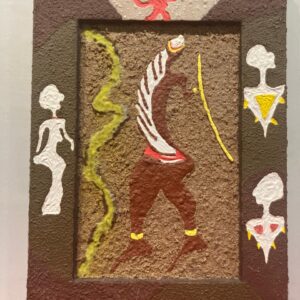
In 2006 I had a secondhand business that closed in 2009. I then met an artist and by God’s Grace gave me Glue with few pages containing Khoisan drawings, that’s where it all started. I then joined the library and read books on the Khoisan, although there were not many.
The Khoisan art was difficult at the beginning, but today I can be proud of my Rock Art myself. The Khoi-Khoi and the Komani San have a nice history inscribed on the caves’ walls. The drawings tell their own stories older nation that first walked here. The coloureds as we are known today. Note! In one of his letters in the daily binders, Simon van De Stel mentions that the coloured person is indeed the descendant of the Khoisan.
Between the 800 to 1400AD at “Mapungubwe” here history was made which was laid bare in the year 1932 and; a large Fund was held by Van Graan, his son and other three who were stationed for the University of Pretoria “Wit Watersrand University”. There, a royal relic was discovered in 24 clay pots. In one clay pot, a male figure with a gold scepter ,a golden bowl and three golden statuettes of animals was discovered. In two other clay pots were found two woman figures with 100 gold bracelets, 12 thousand beads and 26 thousand glass beads .India, China, and Turkish traded here at Mapungubwe. India had with spices, China with silk and the Turks were melters who taught the Khoi the art of melting. 1488 when the khoi name was renamed to cape by Bartomeus Dias and 1510 the quarrel with commander D’Almeide, he and 66 moons are still here. Van Riebeeck in 1648 and later in 1652.
Showing all 4 results