

Description
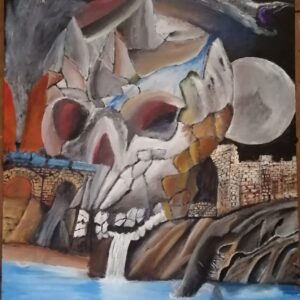
Acrylic on Stretched Canvas
145 x 56cm
The Ruins of The Imaginal Body is an ongoing series of twelve acrylic on canvas paintings, each of different scale, exploring psychic fragmentation, memory, trauma, and transformation. Created in the aftermath of a profoundly traumatic period, these works serve as a visceral travel journal, a collection of diary entries charting a journey through a landscape of shattered trust and intense psychological upheaval. Each painting within the series is imagined as a kind of journal fragment – a field note or sketch
taken by an inner traveler descending into the soft, ruinous landscape of the body-as-world.
The series plunges the viewer into a post-apocalyptic world, where the very ground appears coated in blood, and the air is thick with a palpable sadness and pervasive loneliness. Ancient forests loom as dark
recesses of the psyche, and mountains reveal themselves as cavernous, concealing hidden truths within their depths. Dominated by fleshy pinks, lurid yellows, and spectral whites, the works evoke the interior
body and psyche, transforming personal trauma into symbolic landscapes. Amidst this chaos, the unexpected emergence of architectural forms – a new motif in the artists practice – provided a crucial sense of order, a conscious attempt to construct meaning and structure in a fractured reality.
Drawing from Jungian psychology, the Hero’s Journey, and the collective unconscious, the artist depicts mythic descent (katabasis) through ruined architectures and otherworldly spaces – what Henry Corbin termed the mundus imaginalis. This body of work is a raw, unflinching confrontation with the darkest aspects of the human psyche and the enduring impact of profound relational trauma. It grapples with the complex echoes of past choices, particularly those made to safeguard one’s deepest instincts and future self. The cathartic act of painting, with its visceral drips and textures, became a therapeutic process – a tangible reminder that life, like blood, flows on, and that pathways and rivers of existence continually
converge and diverge, even after immense upheaval. These paintings function as psychic reliquaries: luminous, visceral, and emotionally charged. Influenced by Winnicott’s theory of transitional objects, these
artworks become tools for transformation. The series is a testament to the soul’s enduring capacity to wrestle with its wounds, to find beauty in the broken, and to forge new paths through the very heart of desolation, ultimately revealing the profound resilience inherent in reconstruction. Serving as both personal exorcisms and communal rituals, the series invites viewers a glimpse into a shared wilderness of the psyche, witnessing a layered, mythic journey through personal and collective psychic spaces – where wounds and beauty, destruction and regeneration, exist in continuous dialogue. While rooted in her experiences as a woman and artist in Cape Town, these works speak to universal cycles of fracture,
healing, and becoming.